Framework
The Other Half: Why $366 Billion in Leadership Training Keeps Failing
FI Labs · 2026-09-21 · 8 min read
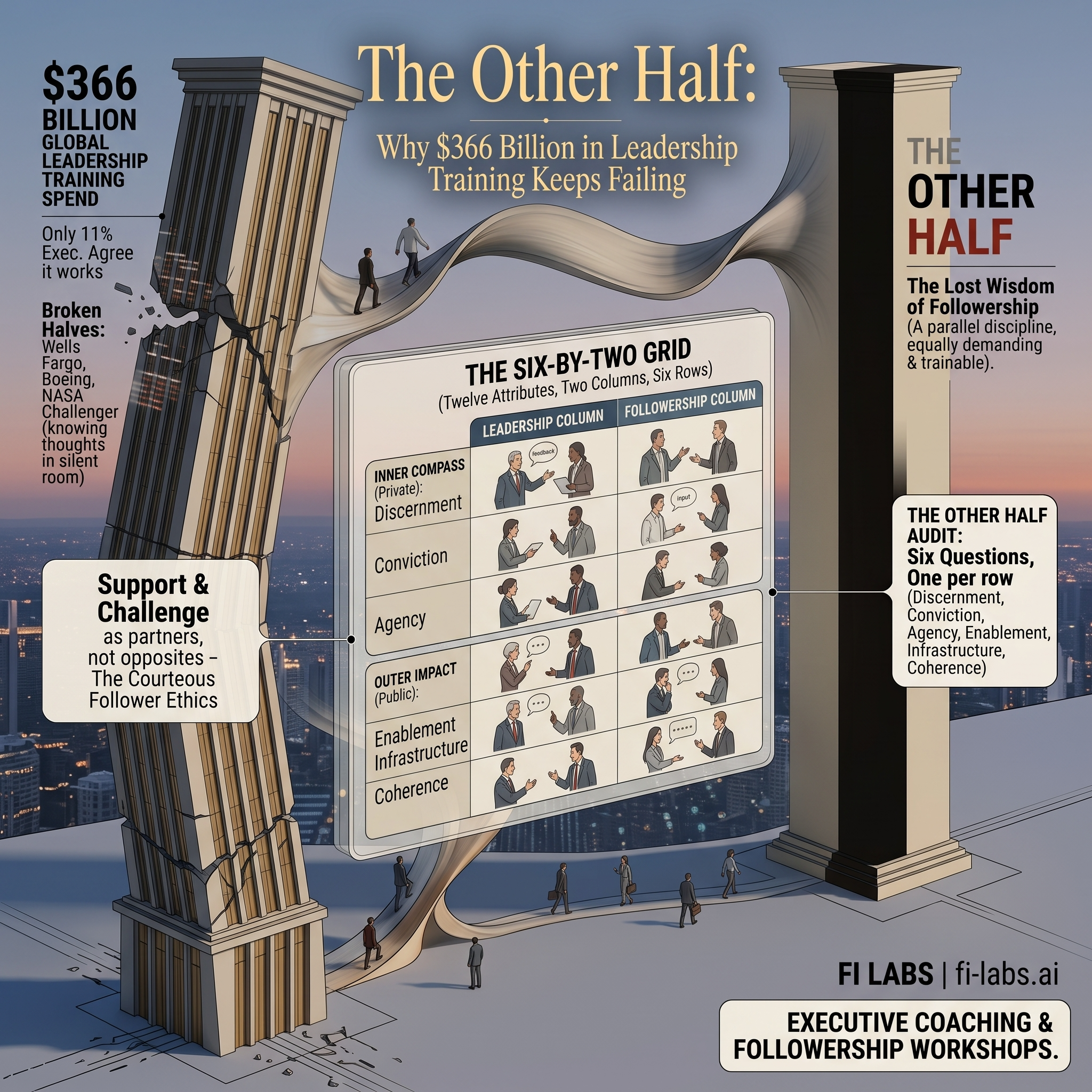
Why the most consequential half of organizational life is the half nobody has been taught.
There is a silence that follows a good presentation.
The slides have landed. The strategy is sound. The leader spoke with conviction. And yet the room keeps looking forward, waiting for something the leader cannot supply. The next quarter will reveal whether that strategy moved through the building or only through the deck — and the people who already knew, that afternoon, that it would not, have long since returned to their inboxes.
Most leadership books end where that silence begins.
The Numbers That Should End the Argument
Organizations spend roughly $366 billion a year on leadership development worldwide, about $166 billion of it in the United States. Only eleven percent of executives say those programs achieve what they were built to achieve. Three in four training professionals believe less than half of what they teach ever reaches the job. In one survey, eighty-two percent of managers entered their roles with no formal training at all.
Line those figures up and what emerges is not a market that misfires occasionally. It is one where the average dollar buys almost nothing measurable. A company that allocated capital this way would answer to shareholders within the year — and yet the spending only grows.
The usual explanation is better content, better delivery, sharper measurement. The honest answer is structural: leadership development fails so reliably because it builds only one half of a two-sided relationship and assumes the other half will take care of itself.
It does not. A vision that cannot be received cannot be carried out. A leader's signal can never be louder than the permission an organization has given itself to hear it.
The Half No One Taught You
Take a private inventory.
Think of what has been spent on your development. The first-time-manager program. The executive education week at a school whose name still sits in your bio. The 360s, the psychometrics, the coach you kept and the coach you did not.
Now look for the other half. Find the day someone taught you how to be led well — not how to comply, but with judgment. The module on disagreeing hard and then committing completely, without the reservation that leaks out later in a corridor.
There is no such folder.
Most readers cannot name a single hour of formal training in the other half of what they do. It is not that you skipped it. It was never offered — because no one built the curriculum, because no one named the subject.
Robert Kelley named it in the Harvard Business Review in 1988, arguing that effective followers form a distinct and trainable category. He later estimated that leaders account for perhaps a fifth of an organization's success and followers for the remaining four-fifths. The article was widely cited, mildly controversial, and set aside.
The Six-by-Two Grid
The Other Half supplies the missing half as a map: twelve attributes, two parallel columns, six rows.
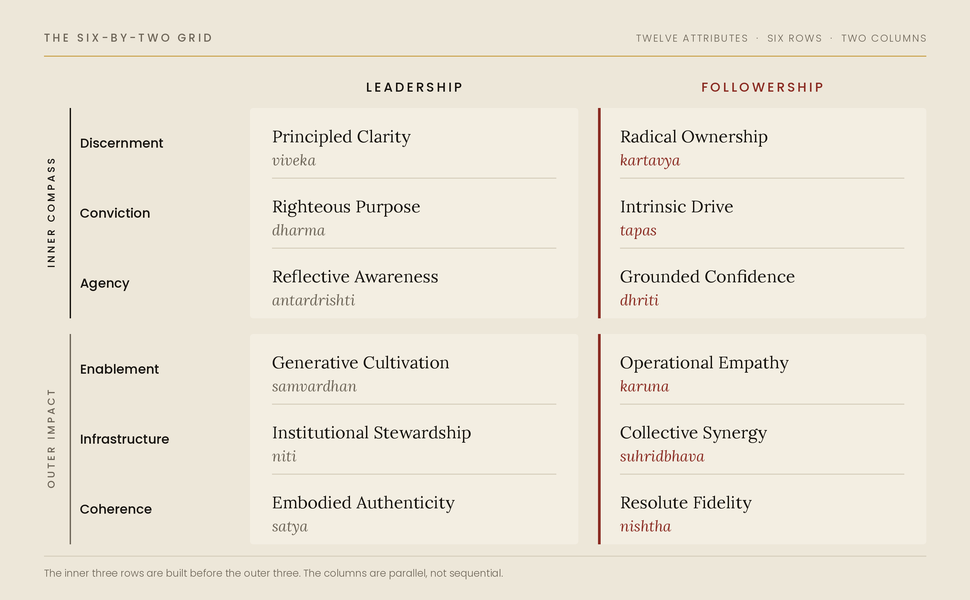
The Foundational Intelligence framework, on one page.
Read it left to right first. The columns are parallel, not ranked. Every row names one human capability and gives it two forms — one for the person leading, one for the person being led. Neither is a junior version of the other.
Read it top to bottom next. The first three rows are the inner compass: private, seen by no one directly. The last three are the outer impact: public, felt by the whole organization. That order is not decoration. No outer attribute rises while its inner root stays dark.
Each attribute carries a Sanskrit term alongside the English, and the rule is strict: the Sanskrit has to reach a depth the English cannot, or it does not earn its place. Take ownership — in English, a manager's word, as in take ownership of the deliverable. Kartavya is heavier and cleaner: that which must be done. It names a duty that exists before anyone assigns it. English makes ownership something you are given; the Sanskrit makes it something you already carry.
The Hinge: Nobody Lives in One Column
The most stubborn misconception in the field is that leaders and followers are different kinds of people.
If that were true, developing followership would mean improving the lesser kind — training for the people who did not make the cut. No wonder no one funds it. No wonder the word stings.
But identity at work is fluid and situational. A chief executive follows her board, the market, the customer, and the mission. A first-week analyst who builds a dashboard the whole firm comes to rely on has just exercised a leadership attribute. The same person crosses the grid many times in a single day, because the grid maps what a moment asks of you rather than a label fixed to your title.
That is what makes the framework usable. It is not a tool for sorting people but for building the full range inside each person — because each person already lives the full range, trained for it or not.
It also explains the cost of getting this wrong. Boeing built superb aircraft and a culture in which engineers who saw danger did not feel free to stop the line. Wells Fargo set brilliant targets and a system that punished the honest. At NASA, on the night before Challenger, people in the room knew — and the room did not make it safe to say so.
Brilliant halves. Broken wholes.
Support and Challenge Are Not Opposites
If one teaching in the book transfers immediately, it is this one.
Ira Chaleff's ethic of courageous followership turns on a distinction most organizations never make explicit: support and challenge are partners, not opposites. The follower who supports without ever challenging is the courtier — agreeable and useless. The follower who challenges without ever supporting is the malcontent — correct and unbearable.
The courageous follower does both at full strength. She stands behind the leader's purpose and, precisely because she stands behind it, tells the leader the truths no one else will.
We made a related argument in The Team of Rivals Paradox: the people most likely to challenge a design are the people most essential to building it. Chaleff's ethic is that same insight as a personal discipline rather than a hiring principle.
From Book to Practice
A framework that stays on the page is a poster. The book is built to be worked, and so is the practice around it.
Executive coaching. The Radar — the book's twelve-attribute self-assessment — is built as a coaching instrument rather than a survey. It produces two hexagons, one per column, and the diagnosis lives in the gap between them. The most dangerous cell is never the one scored low, because a visible weakness is already halfway to a development plan. It is the cell where your own rating and your team's rating pull furthest apart: the capacity you are certain you have and they are certain you lack.
Leadership-followership workshops. Most organizations, held against the grid, are lopsided in a predictable direction — the leadership column is tended, the followership column is assumed, and the inner rows are neglected in favor of the outer ones that show up on a dashboard. Workshops make that lopsidedness visible across a team at once, which is the first step toward fixable.
Ninety-day cohort programs. Translating twelve attributes into the architecture of one particular institution takes longer than a day offsite. Cohorts work the rows in sequence — inside before outside, person before system. Details at fi-labs.ai/workshop.
The Other Half Audit
Six questions, one per row, aimed at the column you have never measured:
Discernment — Do people here claim what is theirs to do before anyone assigns it, or does work sit unowned until a name is attached to it?
Conviction — Does the drive in this organization survive the long, unwatched middle of a project — or only the parts with visibility?
Agency — When someone disagrees with a decision, can they say so and then commit completely? Or does the reservation leak out later, in corridors?
Enablement — Do people ask what a colleague actually needs to succeed before acting — or execute their own part correctly and let the seams fail?
Infrastructure — Does goodwill turn capable individuals into a team, or does this run on strong performers who never quite cohere?
Coherence — Is anyone here steadfast to the mission when circumstances argue for walking away — and would you know who?
If the questions feel harder to answer than their leadership-column equivalents, that is the finding. You have language and instrumentation for one half and instinct for the other.
Closing Thought
There is an old line in the Indian tradition, older than any corporate case: the disciple makes the guru. Without the disciple's attentive presence, the master's words are merely sound. With it, the same words become a transmission.
The transmission is the whole point. The leader's eloquence is only the visible half of what is actually happening.
Greatness is not what the leader hands to the room. It is what the room and the leader make together.
The Other Half: The Lost Wisdom of Followership by Biren Gandhi, with a foreword by Mohak Shroff, President of Platforms and Digital Work at Microsoft. Details at birengandhi.com/toh; available on Amazon and Pothi.
If your organization runs on followership and has no vocabulary for it, FI Labs offers executive coaching, leadership-followership workshops, and ninety-day cohort programs built directly on this framework — fi-labs.ai/workshop.