Technology
The Memory Mirage: Why Bigger Context Windows Won’t Create Wise AI
FI Labs · 2026-05-13 · 5 min read
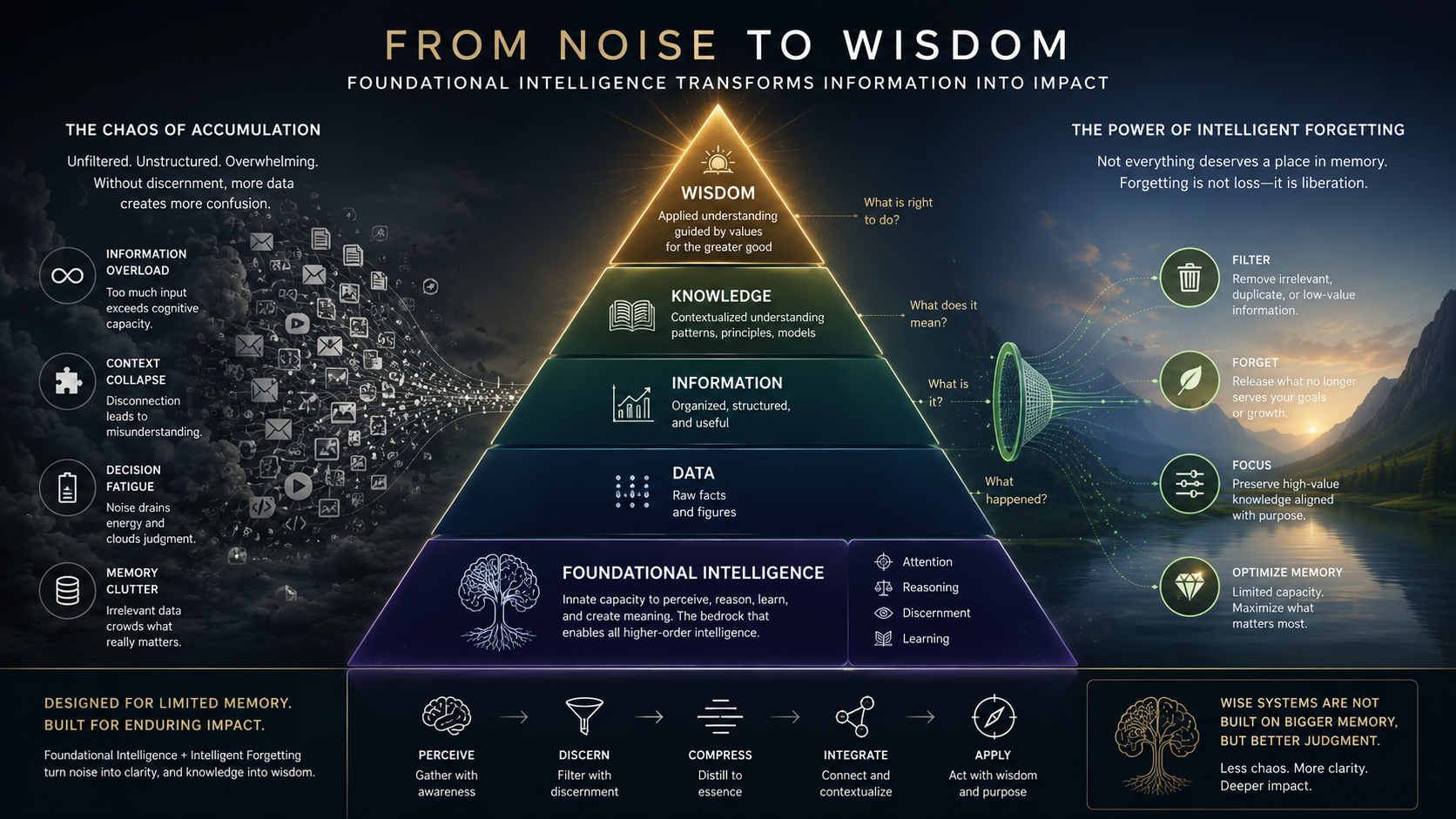
The Memory Mirage: Why Bigger Context Windows Won’t Create Wise AI
Why the future of AI may depend less on remembering everything and more on knowing what matters.
The AI industry is entering a new phase.
For years, the race focused on model size, benchmark scores, and inference speed. Today, the focus has shifted toward persistent memory, long-context reasoning, AI agents, and personalized assistants.
Every major AI platform now wants to remember you.
Your conversations. Your preferences. Your workflows. Your habits.
The assumption behind this shift is simple:
More memory will create more intelligent systems.
But memory is not wisdom.
And context accumulation is not the same thing as foundational intelligence.
The Illusion of Infinite Context
Modern AI systems increasingly operate under a philosophy of accumulation:
- Expand the context window
- Add persistent memory
- Retrieve more documents
- Store more user signals
Technically, this improves continuity.
But it also raises a deeper question:
At what point does information density become cognitive noise?
Humans already face this problem.
We live in the most information-rich era in history, yet distraction, burnout, and decision fatigue continue to rise. Access to information does not automatically create clarity.
Often, the opposite happens.
The signal gets buried beneath accumulation.
AI systems risk the same outcome.
A model that remembers everything may still fail to understand what matters.
Ancient Systems Optimized for Compression
Long before digital memory systems existed, ancient knowledge traditions faced a similar challenge:
How do you preserve complexity without overwhelming cognition?
Ancient Indian systems solved this through layered compression:
- Sutras
- Mantras
- Stories
- Analogies
- Guided interpretation
The goal was not infinite storage.
The goal was preserving foundational principles capable of generating insight across changing contexts.
A single sutra could unfold into decades of interpretation. A short dialogue could encode an entire philosophy.
Modern AI systems often prioritize retrieval. Traditional systems prioritized internalization.
One stores information externally. The other transforms cognition internally.
That distinction matters.
The Next Frontier: Intelligent Forgetting
The next frontier in AI may not be larger memory.
It may be intelligent forgetting.
Human intelligence depends heavily on selective filtering:
- ignoring irrelevant input
- compressing complexity
- prioritizing significance
- forgetting aggressively
Ironically, forgetting is not a flaw in intelligence.
It is one of the mechanisms that enables intelligence.
Many AI agents today increasingly behave like infinite notebooks — continuously appending memories, retrieval chains, and context histories.
But without principled compression, systems accumulate what might be called cognitive sediment:
Layers of context that eventually reduce clarity instead of improving it.
People today are rarely information-poor. They are meaning-poor.
AI may eventually face the same challenge.
From Artificial Recall to Foundational Intelligence™
The real challenge in advanced AI is no longer just model capability.
It is cognitive architecture.
An intelligent system must know:
- what to remember
- what to ignore
- what to revisit
- what to compress
- what to forget
This is where foundational intelligence becomes important.
At FI Labs, we often distinguish between systems that accumulate information and systems that organize reality coherently.
One produces scale. The other produces judgment.
The future of AI may belong not to infinite context machines, but to systems capable of disciplined cognition:
- selective attention
- reflective reasoning
- principled compression
- adaptive forgetting
- contextual discernment
That idea feels surprisingly ancient.
And increasingly necessary.
The next frontier in AI may not be larger memory. It may be intelligent forgetting.
Closing Reflection
The AI industry often assumes intelligence emerges automatically from scale.
But history suggests something more nuanced.
Civilizations did not endure because they remembered everything. They endured because they preserved what mattered most.
As AI systems become deeply integrated into human cognition and decision-making, the defining challenge may not be how much machines can remember.
It may be whether they can learn the architecture of meaningful attention.
That is not merely an engineering problem.
It is a foundational intelligence problem.
If you're building AI systems, agents, or governance frameworks and want to explore how foundational intelligence can shape more coherent, trustworthy architectures, FI Labs can help design systems optimized not just for scale — but for clarity.