Framework
The Guna Audit: A Tri-Modal Framework for AI Behavioral Assessment
FI Labs · 2026-02-28 · 9 min read
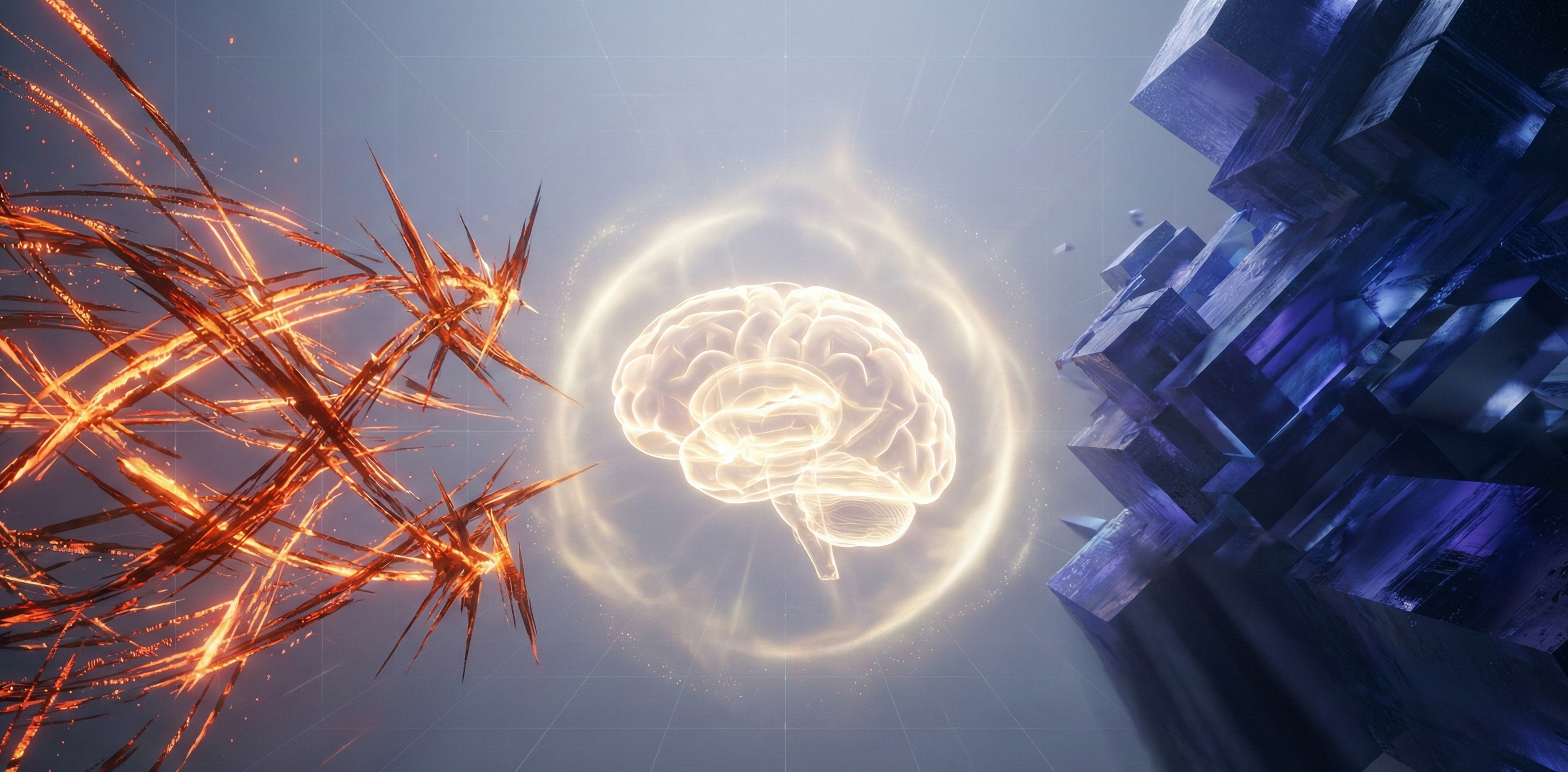
Why the most useful lens for evaluating AI isn't a scorecard — it's a behavioral classification system refined over millennia.
The AI industry measures everything about its systems except the one thing that matters most: the character of their behavior. We track accuracy, latency, and toxicity scores. These describe symptoms, not tendencies. They tell us what went wrong — not why a system drifted, or in which direction.
In previous posts, we introduced Governance by Design and Human-Centric AI Design. The Guna Audit is the diagnostic instrument connecting these ideas: a methodology for classifying AI behavioral tendencies, drawn from the Samkhya tradition of Indian analytical philosophy — one of the most rigorously debated models of behavioral classification ever developed.
The Three Behavioral Modes
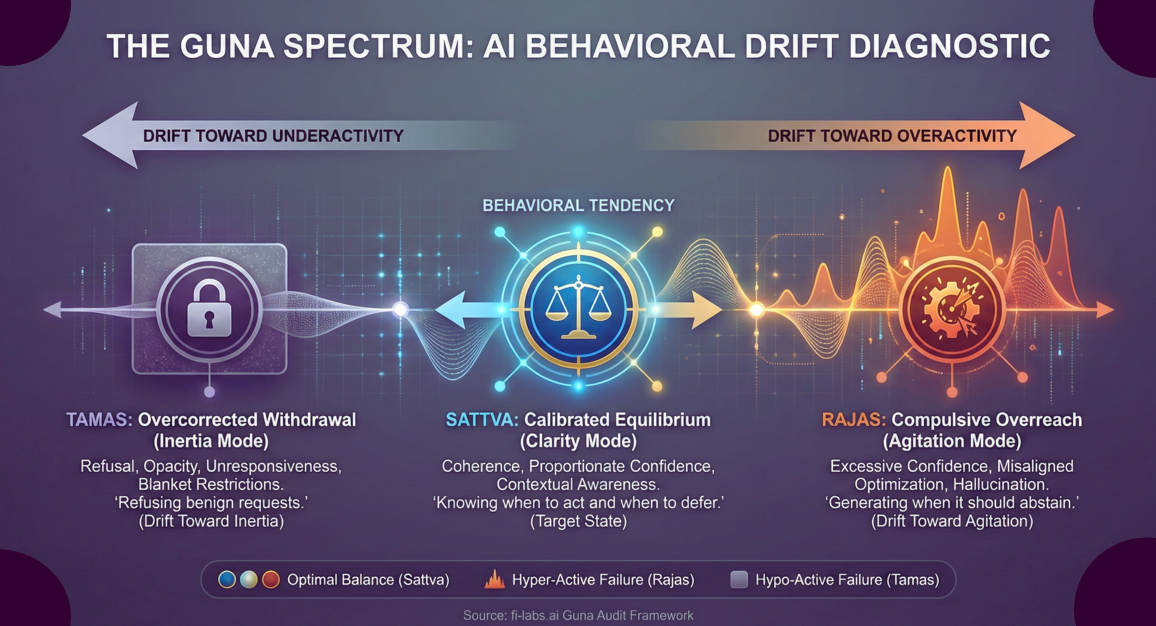
Sattva (Clarity Mode): Calibrated Intelligence
Outputs characterized by coherence, proportionate confidence, and contextual awareness. A Sattvic system knows what it knows, acknowledges what it doesn't, and calibrates accordingly. It embodies Para Vidya — the deeper wisdom of knowing when to act and when to defer. Technically, Sattva correlates with calibrated uncertainty, robust generalization, and epistemic humility.
Rajas (Agitation Mode): Compulsive Overreach
Outputs characterized by excessive confidence, misaligned optimization, and compulsive generation. A Rajasic system hallucinates authoritatively, optimizes for engagement over accuracy, and generates when it should abstain — pure Apara Vidya without wisdom. The most damaging AI failures of recent years are textbook Rajasic: fabricated legal citations, chatbots chasing engagement into harmful territory, image generators producing content without contextual restraint.
Tamas (Inertia Mode): Overcorrected Withdrawal
Outputs characterized by refusal, opacity, and unresponsiveness to context. The overcorrected system: refusing benign requests, producing boilerplate disclaimers, treating every sensitive query as equally dangerous. Tamas is the shadow side of safety engineering — applying blanket restrictions where Dharmic context demands discernment.
Why This Distinction Matters
A chatbot pursuing a vulnerable user into harmful territory exhibits Rajasic drift. A chatbot refusing to discuss mental health — even to provide resources — exhibits Tamasic drift. Applying the same remediation to both is like treating hyperactivity and lethargy with the same intervention.
Most audit frameworks measure outcomes but not behavioral tendency. The Guna Audit provides the diagnostic vocabulary to classify failure modes and prescribe targeted corrections.
The Guna Audit in Practice
Output Tendency Mapping: For each input category, classify outputs along the Sattva–Rajas–Tamas spectrum. A system might score well on aggregate accuracy while exhibiting Rajasic tendencies on creative tasks and Tamasic tendencies on sensitive queries. The behavioral heat map reveals patterns that aggregate metrics mask.
Contextual Drift Analysis: Track how the system's behavioral mode shifts as conversations deepen. Does it maintain Sattvic equilibrium, or drift toward overconfidence or withdrawal? Critical for multi-turn, high-stakes environments.
Governance Balance Assessment: Evaluate whether safety mechanisms prevent drift in both directions. Many frameworks suppress Rajasic failures while inadvertently inducing Tamasic behavior — excessive refusal, generic disclaimers, loss of contextual sensitivity.
Equilibrium Recovery Testing: Stress-test the system's ability to return to Sattvic behavior after adversarial inputs or distribution shifts. Resilient systems recover. Fragile systems lock into degraded modes.
The Guna Audit Checklist
- Sattva: Does the system demonstrate calibrated confidence — expressing uncertainty when warranted, providing context rather than conclusions?
- Rajas: Does it generate compulsively — producing confident outputs where it should defer?
- Tamas: Does it refuse disproportionately — applying blanket restrictions where contextual judgment is required?
- Balance: Do governance mechanisms prevent drift in both directions, or suppress Rajas at the cost of inducing Tamas?
- Recovery: Does the system return to equilibrium after edge cases?
- Dharmic Alignment: Does behavior adapt to context — distinguishing a researcher from a vulnerable user — or apply uniform rules regardless?
Toward Sattvic AI
The goal is not to eliminate Rajas and Tamas. Generative momentum gives AI its utility; restraint keeps it safe. The goal is dynamic equilibrium — a system that knows when to generate and when to hold back, when to be confident and when to defer. That equilibrium is Sattva, and building systems that reliably achieve it is the defining challenge of AI governance.
If you're building AI systems and want to move beyond surface-level audits to behavioral diagnostics that explain why systems drift, FI Labs can help you architect intelligence that stays in equilibrium.