Framework
Artificial, Applied, Actual: Why AI That Works Still Changes Nothing
FI Labs · 2026-08-26 · 7 min read
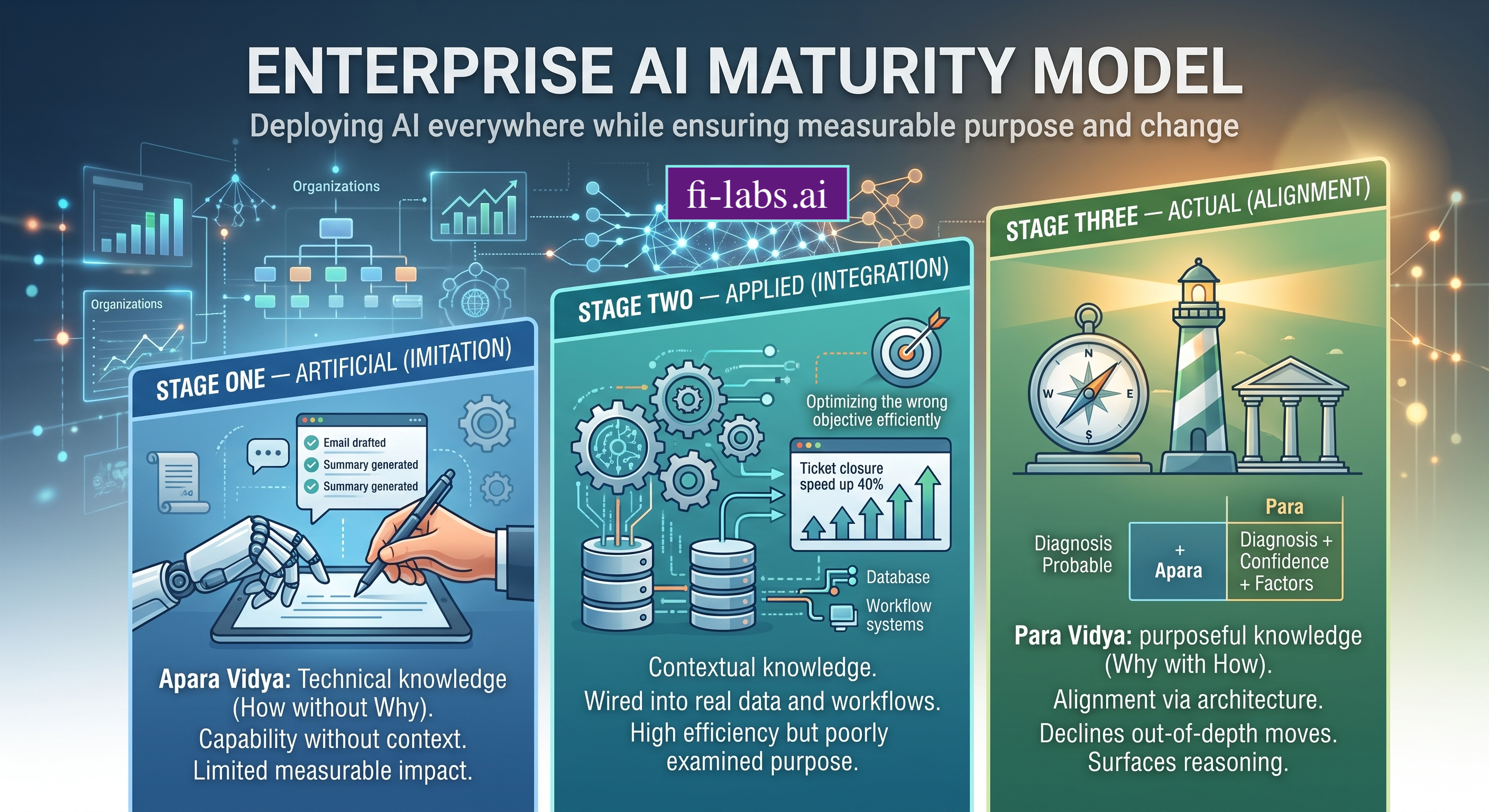
A maturity model for organizations that have deployed AI everywhere and still can't say what it changed.
By mid-2026, the enterprise AI conversation has acquired an uncomfortable center of gravity.
Study after study through the year has converged from different directions on the same result. The large majority of generative AI pilots produced no measurable impact on profit and loss. Adoption of agents is near-universal in intent and rare in production. Boards have stopped counting pilots and started counting dollars.
The detail that matters most is easy to lose in the noise:
In most of these failures, the technology worked.
The models performed. The benchmarks held. The demos were real.
And nothing changed.
That is not a capability problem. It is a maturity problem — and it has a shape.
Two Versions of the Same Gap
In The Karma of Agentic AI we argued that the missing capability in autonomous systems is not another tool. It is the ability to recognize it has left the territory it was built for, and stop.
That is the same gap this post is about, viewed from the organizational level rather than the runtime.
An agent that cannot tell when to stop is a system that was never told what it is for. Scale that up — across a portfolio, a function, a company — and you get an AI program that is busy, capable, expensive, and directionless.
Purpose is the thing that is missing. It goes missing in three distinct stages.
Stage One — Artificial: Imitation
The first stage is imitation. The system produces outputs that resemble what a competent person would produce. It drafts the email, summarizes the document, writes the function, answers the question.
This is Apara Vidya — a Vedic term for technical knowledge, the "how" without the "why," as we described in The Intersection of Vedic Wisdom and Machine Learning.
Genuinely useful. Genuinely limited.
The signature of Stage One is that the system has no idea what it is for. Capability without context.
Ask it to draft a customer email and it will produce a well-formed email — with no knowledge of that customer's history, your commercial position, or the three things you must never put in writing.
Most enterprise AI in 2026 is Stage One with better branding. Not coincidentally, that is also where most of the unmeasurable pilots live.
Stage Two — Applied: Integration
The second stage is integration. The system is wired into real context — your data, your workflows, your constraints, your tools. It knows the customer's history because it can retrieve it. It respects the compliance boundary because the boundary is enforced in the stack.
This is a real leap, and it is where serious engineering effort currently concentrates.
But Stage Two has a specific and under-discussed failure mode:
It optimizes whatever it is pointed at, with increasing effectiveness.
A system aimed at a badly chosen metric will pursue that metric more efficiently than any human could. Engagement over understanding. Ticket closure over problem resolution. Speed over judgment.
Stage Two systems don't fail by being wrong.
They fail by being extremely right about the wrong objective.
Stage Three — Actual: Alignment
The third stage is alignment — not in the narrow safety sense, but in the plain sense of a system standing in the right relationship to the work it serves.
An Actual Intelligence system knows what it is for, in a way that constrains what it will do. Its purpose is enforced in the architecture rather than described in a prompt. It surfaces the reasoning a person needs instead of ending their thinking with an answer. It declines when it is out of its depth. It optimizes for outcomes that stay good at longer horizons than the current quarter.
This is Para Vidya — foundational knowledge, the "why" that gives the "how" its direction.
The difference is observable, not decorative:
- A Stage Two medical system returns the most probable diagnosis. A Stage Three system returns the diagnosis, its confidence, what would change its mind, and what the clinician should examine that the model cannot see.
- A Stage Two recommendation engine maximizes time on platform. A Stage Three engine, as we argued in Beyond Optimization, measures whether the user's judgment improved.
- A Stage Two agent completes the task. A Stage Three agent recognizes when completing the task is the wrong move.
Why Stage Two Feels Like Success
Here is the trap.
Stage Two produces excellent local metrics. Efficiency rises. Cost per task falls. Dashboards look strong.
Nothing in that picture tells you that you have built a highly capable system pointed at a poorly examined objective.
The signal arrives later, and sideways. As a P&L that never moves despite everything working. As people who have stopped exercising judgment because the system always has an answer. As an incident where nobody can say why the system did what it did.
Which is exactly the shape of the ROI gap the research keeps finding.
Not broken technology. Unexamined purpose, executed efficiently.
Stage Three is not a technical upgrade over Stage Two. It is an act of clarity about purpose, encoded into architecture.
The Three-Stage Diagnostic
For any AI system in your organization:
The Purpose Test: Can this system's specific purpose be stated in one sentence — and is that purpose enforced in the architecture, or merely described in the prompt? (Prompt only → Stage One or Two.)
The Context Test: Does the system have access to the situational reality it is reasoning about, or is it producing plausible output in a vacuum? (Vacuum → Stage One.)
The Refusal Test: Can the system decline? Does it know the edge of its own competence and say so? (No → not Stage Three, whatever else it does.)
The Judgment Test: After a year of using this system, is the person operating it sharper or duller at the underlying task? (Duller → Stage Two, optimizing the wrong thing.)
The Horizon Test: Are success metrics measured in sessions and tickets, or in outcomes that still hold at twelve months?
The Objective Audit: If this system became ten times more effective at exactly what it currently optimizes for, would that be good? (If the honest answer is no — you have a Stage Two system and a Stage Three problem.)
Closing Thought
The industry has spent enormous effort moving from Stage One to Stage Two, and comparatively little on the step that actually converts capability into value.
Artificial intelligence imitates. Applied intelligence integrates. Actual intelligence aligns.
Only the third produces systems that stay valuable when the context shifts, the metric ages, and the edge case finally arrives.
If your AI program is delivering strong metrics and unclear value, FI Labs can help you locate where your systems actually sit — and architect the step you haven't taken yet.